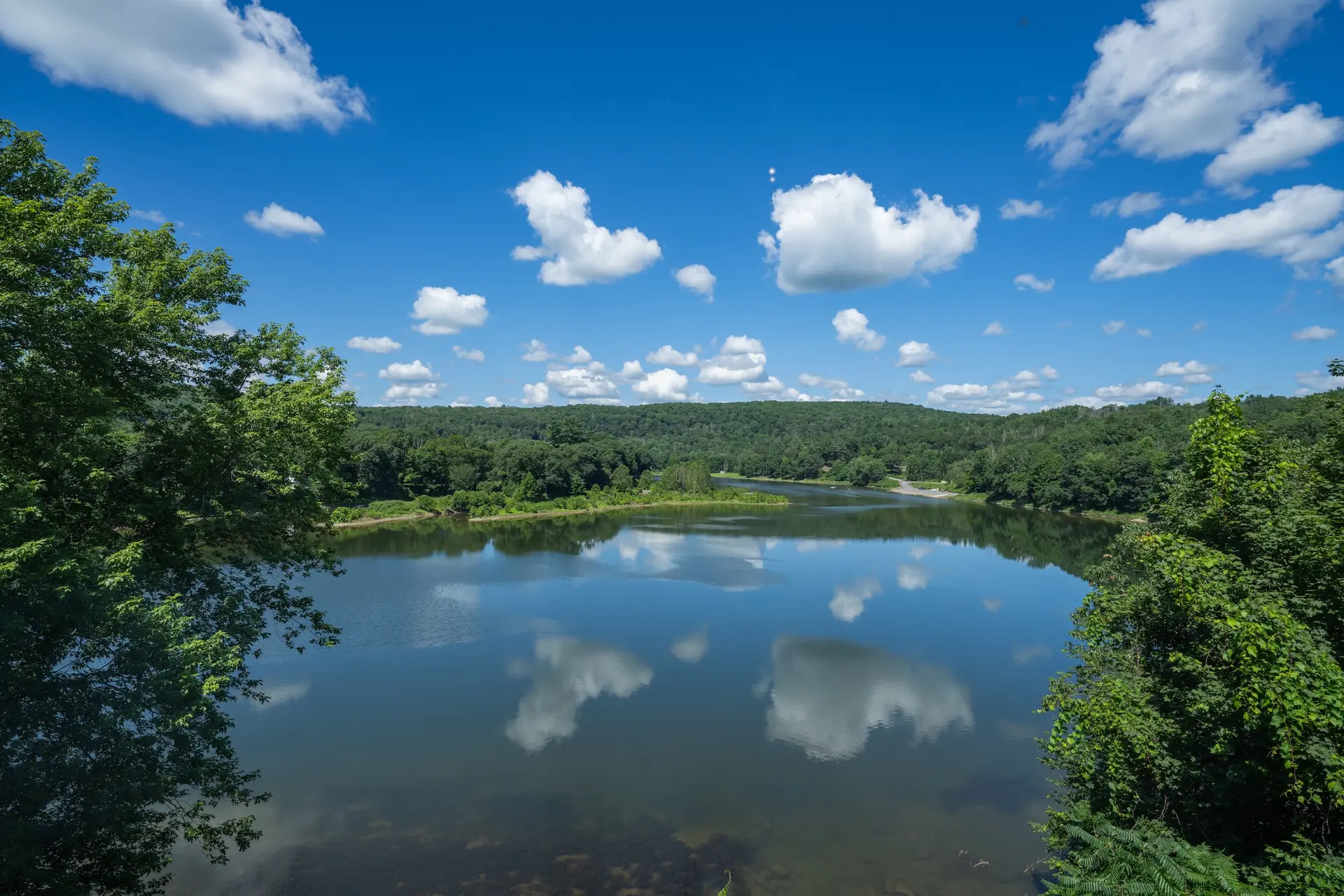
The Upper Delaware River corridor is one of the most important bald eagle habitats in the eastern United States — and you can spot them without ever leaving downtown Narrowsburg.
It's not unusual to be sipping coffee on the deck at the Penthouse and watch a bald eagle ride a thermal directly over the Narrowsburg Bridge. The Upper Delaware River corridor — the 73-mile stretch protected as a National Wild and Scenic River — is home to one of the largest concentrations of wintering bald eagles in the Northeast, along with a healthy resident population that nests here year-round.
Eagles disappeared from this region almost entirely by the 1970s. Today, a successful recovery means you're more likely than not to see one on a clear morning along the river. Here's how to find them.
When to See Them
Peak season: December through mid-March. The Upper Delaware is a wintering ground for eagles migrating south from Canada and the Northeast. When their northern lakes freeze, hundreds of eagles concentrate along the unfrozen stretches of the Delaware to hunt fish. January and February are the densest months — it's possible to see a dozen or more in a single morning.
Year-round residents. A growing number of nesting pairs stay in the corridor year-round, raising chicks in massive stick nests visible high in the white pines along the river. Spring (March–May) is nesting and fledgling season; you'll see adults teaching juveniles to fish.
Best time of day: early morning and late afternoon. Eagles fish actively just after sunrise when the air is still and the water is glassy. Late afternoon — about two hours before sunset — they often perch on dead snags overlooking the river, scanning for the day's last meal.
Where to Look
1. The Narrowsburg Bridge
The single best spot in town. The bridge spans the deepest section of the Delaware (the "Big Eddy" — over 100 feet deep), and eagles love it. Park on either the New York or Pennsylvania side, walk to the middle of the bridge, and scan the trees along both banks. The white pines on the Pennsylvania side, just downriver, are a regular perch.
2. From the Penthouse Deck or Windows
The Penthouse sits two stories above Main Street with direct sightlines to the river. We've watched eagles cruise the corridor from the back windows multiple times a week, especially in winter. Bring binoculars — keeping your distance is also the right thing to do.
3. Skinners Falls
About 10 minutes north of Narrowsburg on Route 97. Eagles hunt the shallow rapids here regularly. There's a small pull-off and trail down to the rocks. More on Skinners Falls here.
4. Lackawaxen / Roebling Bridge Area
About 25 minutes south on Route 97 — the Eagle Institute, a local nonprofit, runs guided eagle-watching tours from this area on winter weekends. They know exactly where the regular birds are perching and bring spotting scopes. Worth the drive if you want to see a lot of eagles in one outing.
5. Mongaup Falls Reservoir
About 35 minutes from Narrowsburg, near Forestburgh — a dedicated eagle observation blind run by NYSEG and the Eagle Institute. This is the most reliable single spot in the region during peak winter season; you can sometimes see 10–20 eagles roosting in the trees around the reservoir.
What to Bring
- Binoculars. 8x42 is the sweet spot — enough magnification to see plumage detail, wide enough field of view to follow a bird in flight. A spotting scope is overkill unless you're really serious.
- Warm layers in winter. The river corridor is exposed and the wind can be sharp. Dress for the temperature minus 10 degrees.
- Patience and quiet. Eagles spook easily. Stay still, talk softly, and let them come to you.
- A camera with a long lens if you're hoping for photos — 400mm minimum. Honestly though: experiencing them with your eyes is better than trying to photograph them.
An important note: Bald eagles are federally protected under the Bald and Golden Eagle Protection Act. Stay at least 330 feet (roughly the length of a football field) from any nest, especially during breeding season. Never approach a nesting tree, never try to provoke flight for a photo, and pack out everything you bring in.
What You'll See
Adult bald eagles are unmistakable — chocolate-brown body, snow-white head and tail, yellow beak, six-to-seven-foot wingspan. Juveniles look completely different for their first four years: mottled brown and white, no white head yet, often mistaken for golden eagles. If you see a large dark raptor along the river that doesn't look like an adult bald eagle, it's almost certainly a juvenile bald eagle — golden eagles are rare in this corridor.
You'll also likely see osprey (smaller, hover-then-dive fishing style), great blue herons, kingfishers, and in winter, common mergansers. The Upper Delaware is one of the richest cold-water fisheries in the East — which is exactly why the eagles love it.
A Perfect Eagle-Watching Morning
Here's how we'd run it. Wake up at the Penthouse around 7:00 AM. Grab coffee and a pastry to-go from The Tusten Cup across the street (they open at 7). Drive 10 minutes north to Skinners Falls, park, walk down to the river. Spend 90 minutes watching — most active period is 7:30 to 9:30 in winter. Drive back through town, stop at the bridge for another scan, then head back to the Penthouse for breakfast and a warm fire. You'll likely have seen 5–10 eagles before most people are awake.
If you only have one morning in Narrowsburg and want a memorable nature experience, this is it.